
Beyond the Badge
Artsmark helped Cumbria schools reimagine the arts
Friday 14 November 2025
We already know the arts and cultural offer for children and young people across England is not equitable. Amongst other economic and social barriers, the place in which a young person grows up has a significant influence on the diversity and quality of arts experiences available to them. Schools can do much to improve access to enrichment and, since 2001, the Artsmark award has supported thousands of schools across the country to develop and raise the standard of their arts provision. However, for some schools – particularly those in rural or semi-rural locations - the challenges of isolation and access are acute.
At Curious Minds we have long championed the Artsmark framework as a tool for transformation in arts provision. But what if I told you that its value can extend far beyond the formal journey? Last academic year, Curious Minds worked with four schools to investigate this idea through our Artsmark Rural Schools project, supported by Arts Council England.
In July 2024, rural or semi-rural schools in Whitehaven and Copeland (two primary and two secondary) were recruited to explore how they could use the freely available Artsmark framework as a tool to develop their provision, in a way that connected meaningfully with their place, people and priorities.
A framework for reflection and growth
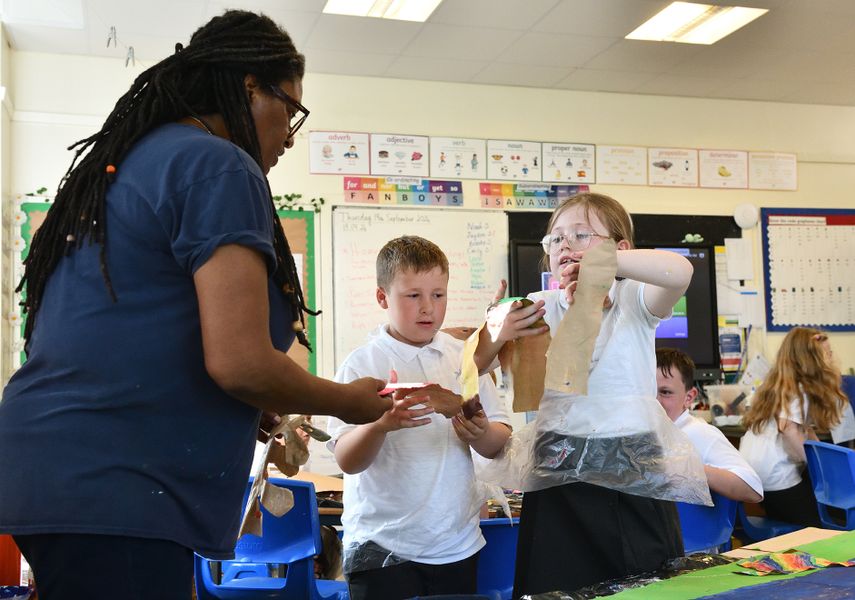
With support from Curious Minds, these schools used the framework to map their current arts and cultural offer and evaluate how well it aligned with the Artsmark Criteria and Quality Principles - from authenticity and inclusivity to risk-taking and reflection - identifying areas for growth. They then planned arts-based projects that responded to the priorities they’d identified. By connecting and working with local arts practitioners, they were able to deliver an exciting range of activities, creating impact that rippled right across their school communities.
As a direct outcome, young people living in these places enjoyed more opportunities to engage with arts and culture in and out of school, which in many cases led to increased enjoyment and confidence, as well as improved skills and behaviour. Schools saw an improvement in wellbeing or an increased uptake of arts-based subjects at GCSE.
The schools involved in this project did not work towards achieving full Artsmark award, as that would not have been realistic or manageable given the project timescales. Instead, they were encouraged to use the framework adaptively to identify opportunity and overcome challenges.
Making it work, even with limited resources
At the heart of the success of this project were teachers with the passion and dedication to tackle obstacles whilst managing conflicting priorities, through a holistic and collaborative approach.
The schools in our project showed that small steps can lead to big shifts. For example:
- A primary school which used the Framework to identify priorities linked to oracy and parental engagement, and then worked with a theatre company to devise an original production, which was performed to parents.
- A secondary school which mapped its arts provision and identified an opportunity to broaden its music offer investing in new music technology equipment and collaborating with a local music production charity.
- A school which commissioned a dance company to deliver a series of workshops specifically aimed at engaging young men.
- A school for which integrating digital media across the curriculum was a key priority - but limited staff confidence was holding things back. Teachers took part in CPD to build their skills and confidence, ensuring ongoing sustainability once the project had finished.
Knowing that the teachers’ time was limited, and resources stretched, schools were helped along the way through a scaffolded programme of support from Curious Minds, including brokerage of connections with arts practitioners and organisations, CPD around commissioning with Teaching Artists as classroom cover for lead teachers during training, and some seed funding for each school to commission and deliver their project.
Inevitably, this programme support removed some of the more acute short-term barriers (around resourcing) that we know schools widely face, but the emphasis of Curious Minds’ scaffolding was to leave teachers with a legacy of knowledge and skills that left them feeling empowered to be creative and continue developing arts provision in their setting.
The schools in our project showed that small steps can lead to big shifts.
“I thought [the creative audit] was an interesting process and offered a lot. It gave us a chance to reflect on what we’re already doing, which areas there are gaps, really helped to find something relevant for the school that would be impactful for the focus.”
Lead teacher
The arts matter now more than ever
The report of the Curriculum and Assessment Review, published on 4th November 2025, and the bold reform commitments outlined in the Government’s response both offer a vision for a rich, inspiring cultural education that lasts a lifetime.
Delivering this universal entitlement will doubtless involve transformational work in schools up and down the country. But schools don’t need to wait to start their journey towards broader and better-quality arts provision. What this project has shown is that reflective practice, supported by a framework like Artsmark, is invaluable. It empowers schools to make intentional choices, rather than reactive ones.
Practical steps to growth
If you’re a teacher or school leader wondering how to begin, here are some simple, actionable steps you can take:
- 1. Audit current provision - you can use the Artsmark framework as an open resource to benchmark the breadth and standard of existing provision.
- 2. Align the arts with wider school priorities - how can creativity support wider goals, such as wellbeing, literacy, or community engagement?
- 3. Start small - choose one area to focus on, using the framework to guide planning and evaluation.
- 4. Connect locally - by reaching out and having conversations with local artists, organisations or cultural venues about their schools offer. What you find may surprise you!
- 5. Build team confidence - explore opportunities for CPD or peer learning that grow creative teaching skills.
- 6. Use the framework to advocate - share your ideas with SLT or governors to build support and unlock resources.
Curious to know more?
If you’re interested to read more about our work supporting schools to improve their arts education and cultural learning offer, visit our School Arts Improvement page.
If you've got questions about any of our projects, you can get in touch using the contact details below.
About the Author